Tirian–Aslan relationship
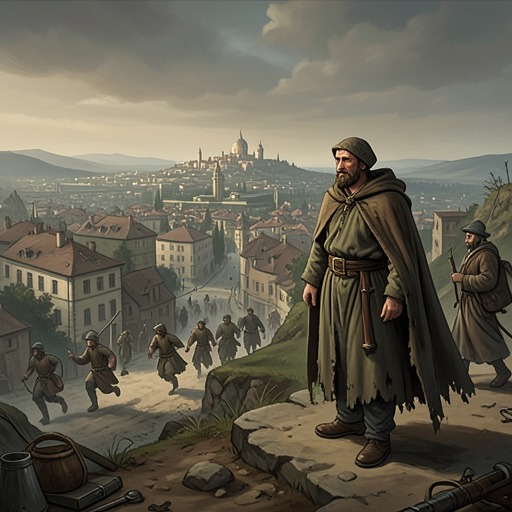
The Last BattleTirian–Aslan relationship is the story of a king whose faith survives both fear that Aslan has become unrecognizable and the long silence that follows his plea for help. Tirian’s belief is not effortless certainty: he is willing to surrender himself to what he understands as Aslan’s justice, even at the cost of his life. At the end, Aslan personally welcomes him at the Stable Door and affirms that he stood firm at Narnia’s darkest hour, giving the relationship its final shape as tested trust answered by recognition.
Faith Under Trial
When Tirian hears that the Horse and the Rat both claim that Aslan has ordered terrible acts, the report threatens more than his safety: it shakes his understanding of the being in whom Narnia has trusted. Jewel asks how Aslan could command such things. Tirian answers that Aslan is not tame, and admits that people who have committed murder cannot presume to know what Aslan might do. On that reasoning, he chooses to return, surrender his sword, place himself in the Calormenes’ hands, and ask to be brought before Aslan for judgment.
Jewel warns that the choice will mean death. Tirian does not dismiss the danger; he says he does not care if Aslan condemns him, because death would be preferable to the fear that Aslan has come and is not the Aslan Narnia believed in and longed for. He describes that spiritual disorientation as a sun rising black. Jewel answers with the image of water that has become dry, then agrees that they should give themselves up. Their exchange makes Tirian’s faith a willingness to face judgment, not a claim to understand or control Aslan.
Prayer and the Call Across Worlds
Tirian’s historical memory sustains his hope when immediate circumstances offer no answer. He recalls that Aslan has appeared in Narnia’s stories, often when events were at their worst, and remembers that children from beyond the world helped Caspian and had once defeated the White Witch. Yet he tells himself that such aid belongs to the past. The recollection becomes a measure of the present crisis: the pattern he longs to trust has not yet repeated itself.
He cries out three times for Aslan to come and help, but darkness, cold, and stillness continue. Tirian then asks not for his own rescue but for all Narnia to be saved. Although nothing changes in the night or the wood, he begins to feel a faint hope and greater strength. He asks Aslan either to come or to send helpers from beyond the world, and then calls the children himself, invoking his authority as King of Narnia, Lord of Cair Paravel, and Emperor of the Lone Islands. His appeal passes into a vivid dreamlike vision of people gathered in a lighted room. The call thus gives his belief an active form: he acts on the possibility of help before he can know whether it will come.
Recognition at the Stable Door
When Aslan appears at the Stable, Tirian is afraid and approaches trembling. He throws himself at the Lion’s feet; Aslan kisses him and calls him the last of Narnia’s kings who stood firm at the darkest hour. The greeting answers the earlier terror that Aslan might no longer be the one Narnia had believed in. It also gives Tirian’s steadfastness explicit recognition from the very authority whose judgment he had been prepared to face.
Aslan’s role at the Door extends beyond this personal welcome. He roars that the time has come, and the Door opens. Creatures who look into his face and respond with fear and hatred turn aside into his shadow; those who love him, even when frightened, enter on his right. The distinction makes the encounter a moment of judgment as well as passage. Tirian’s faith has not made him the judge of others; it has brought him to the threshold where each creature’s response to Aslan is disclosed.
The End of Narnia and the Larger Reality
From beyond the Door, Tirian and the others witness the end of the old world. Aslan tells the Time-giant to make an end; the giant extinguishes the Sun, and darkness follows. Yet the destruction is not presented as the destruction of everything that matters. Digory explains that the Narnia which had a beginning and an end was a shadow or copy of the real Narnia, which has always existed and always will. The dear creatures of the old Narnia have been drawn through the Door into that reality.
Aslan later reveals that a real railway accident has killed the children and their parents in the Shadow-Lands. The disclosure places Tirian’s welcome within the book’s final passage from a world that ends to a greater life beyond it. His relation to Aslan is therefore resolved not by a return to the kingdom he knew, but by Aslan’s recognition and the promise of a continuing story. The king who feared that Aslan’s arrival would mean the collapse of everything he had trusted is welcomed into the reality for which the old Narnia was only a shadow.